Most Viator vs GetYourGuide comparisons are written for travellers choosing where to book a Colosseum tour. This one is for the operators on the other side: the people who pay the commission, wait for the payout and answer the guest when something goes wrong.
How the money moves on each platform
Viator: you are paid a net rate
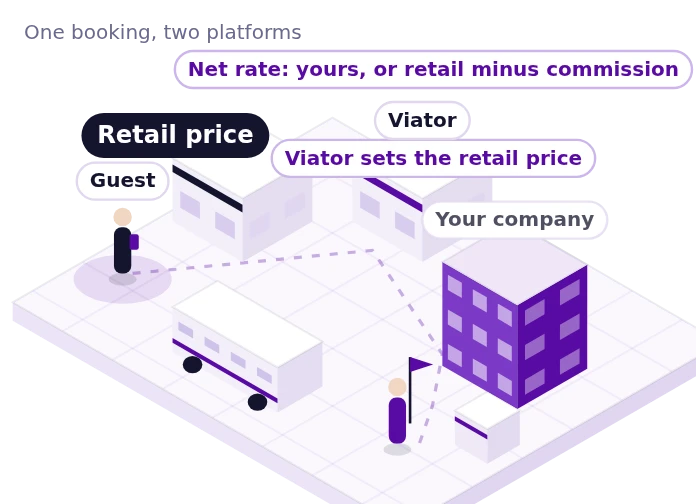
On Viator, you are paid a net rate (the one you set, or retail minus commission) and Viator sets the price the guest sees.
GetYourGuide: commission on retail
On GetYourGuide, commission is a percentage of the retail price, which includes taxes and fees.
Paid after the tour
Both pay after the tour date: GetYourGuide by the 5th business day of the next month, Viator weekly via PayPal or monthly.
Faster money has a price
Faster money costs 2% on GetYourGuide; Viator offers weekly payouts via PayPal.
Scroll the steps or pick a number
A guest booking on Viator and on GetYourGuide: Viator pays you a net rate and sets the retail price, GetYourGuide takes commission on the retail price including taxes, both pay after the tour, and faster payouts cost 2% on GetYourGuide.

CEO & Founder
Tour operator since 2012. Runs tours in Kraków, Warsaw and Gdańsk with the Todo.travel group, 100,000+ guests per year.

Everything below comes from the two platforms' own supplier terms and help pages, with the date we read them, plus published industry data. Where a platform does not publish something, we say so instead of guessing.
Quick Answer
Neither platform publishes one commission rate. Viator sets a minimum per destination and category, sets the retail price and pays you a net rate: yours, or retail minus commission. GetYourGuide charges 20% to 30% of the retail price, depending on the country. Both pay after the tour, with faster options.
Commission Comparison: Viator vs GetYourGuide
Commission is the first question every operator asks, and the honest answer starts with what the platforms do not publish. Viator says "rates vary by location": every product must meet a minimum commission for its destination and category, and new products start at that minimum. GetYourGuide's terms say its commission is "a percentage of the Retail Price for a Booking, as specified in the Supplier Account", and its site says it charges "between 20% and 30% depending on the country in which the activity is provided"; your exact rate is shown in your supplier account. Viator publishes no range: the only figure with a source is an operator telling Arival in 2025 that Viator's basic rate was 27%. Arival also reported GetYourGuide raising some operators from 20% to 30% that July.
What the rate is calculated on matters as much as the rate.
| Topic | Viator | GetYourGuide |
|---|---|---|
| How your rate is set | Minimum per destination and category; new products start at the minimum; no published range | Between 20% and 30% depending on the country (GetYourGuide's site); your rate is shown in your supplier account |
| What it is calculated on | Viator sets the retail price and pays you a net rate: the one you set, or, under the agreement in force since 1 August 2026, your retail rate minus a commission percentage if your booking system sends only retail prices | The retail price, which includes taxes and fees; VAT on the commission is added where it applies |
| Paying more for visibility | Viator Accelerate: raise your commission above the minimum for ad impressions; even one point counts; opt out at any time; not open to connected products that send only a net price | A voluntary commission increase "may have a positive effect on ranking, but does not guarantee any position" |
| Commission increases | No commission-specific rule found; any change to the agreement needs at least 15 days' notice, and you can terminate within that period | Only if its operating costs rise, applied uniformly, with four weeks' notice; normally no more than once per calendar year (exceptions for regulatory or other material cost increases); if the increase is 20% or more of your current rate, you can terminate within 30 days |
| Fee to list | One-time, non-refundable $29 per experience (manual review and Launch Assist) | No listing fee ("no cost for adding and maintaining an activity") |
Terms and help pages checked on 30 October 2026.
Viator Accelerate is worth understanding before you switch it on. Viator says that, with popularity and reviews equal, "the more you contribute via commission, the more we promote your product through ad impressions", and its August 2026 agreement adds that higher commission can also earn "a better position in the ranking". That visibility is paid for: the extra ad impressions are tied to the extra commission.
For what these percentages cost you per tour, see OTA commissions explained.
Payout Speed: When Do You Actually Get Paid?
Both platforms pay you after the tour date, not when the guest books.
| Topic | Viator | GetYourGuide |
|---|---|---|
| Standard | Monthly via bank transfer or Payoneer, after the travel date (sign-up page). The agreement's 21-business-day term applies outside the EU and UK; EU suppliers are paid under separate EU payment terms | Monthly, processed by the 5th business day, for tours that ran the previous month |
| Faster option | Weekly via PayPal (sign-up page) | Twice a month for an extra 2% (help centre: around the 5th and 20th; the terms say by the 5th and 20th business day); starts from the following month |
| Methods | Bank transfer, PayPal or Payoneer | Bank transfer or PayPal; you choose the payout currency |
| Minimum | Outside the EU and UK, payments under $50 can be held until the balance reaches $50; for EU suppliers, payouts of €45 or less roll over to the next payment date | EUR 50 minimum: smaller amounts can be held until a later payout |
| Arrival | Normally 2 to 3 business days after the transfer, up to 5 depending on your bank | Bank transfers can take until the 12th business day to arrive; PayPal up to 24 hours |
Viator suppliers based in the EU are paid under its payment terms for EU suppliers, not the 21-business-day schedule of the general agreement.
Whether GetYourGuide's twice-monthly option is worth 2% depends on your cash flow. If you pre-pay permits, vehicles and seasonal guides, earlier money has a real value; if not, the monthly run costs nothing extra.

API & Booking Engine Integration
If you use a booking system, you can connect both platforms through it rather than by hand. Viator says it integrates with "over 100 systems", including Bókun, Bookingkit, FareHarbor, Peek Pro, Regiondo, Rezdy and Ventrata. Viator's summary of its August 2026 agreement says that, for connected suppliers, the live data from your booking software is "the absolute 'single source of truth'", which means rate and availability errors sent by your system are your responsibility. GetYourGuide's Supplier API connects to systems including Bókun, FareHarbor, Ventrata, Bookingkit and Checkfront, and any fees your connectivity partner charges are yours to pay. Viator and Bókun are both owned by Tripadvisor, which bought Bókun in April 2018.
If you are still choosing a booking engine, our booking engine pricing comparison shows which ones connect to which OTAs. For the wider picture, our tour operator software guide compares booking engines, OTA distribution and operations platforms side by side.
Customer Support: Who Has Your Back When Things Break?
Viator runs supplier support 24 hours a day in English, by chat in the Management Center and by phone, with Spanish and Italian at set hours. GetYourGuide runs a supplier support chat, still labelled beta, open 24/7 to active suppliers in English, Italian, French, Spanish and German, and sends more complicated issues to its contact form. We found no published response times or account-manager thresholds from either platform, so ask during onboarding.
Both set deadlines for you as well. Viator expects suppliers to answer customer complaints and requests within 24 hours; GetYourGuide expects answers to its own questions within one business day.
Listing Requirements & Approval Process
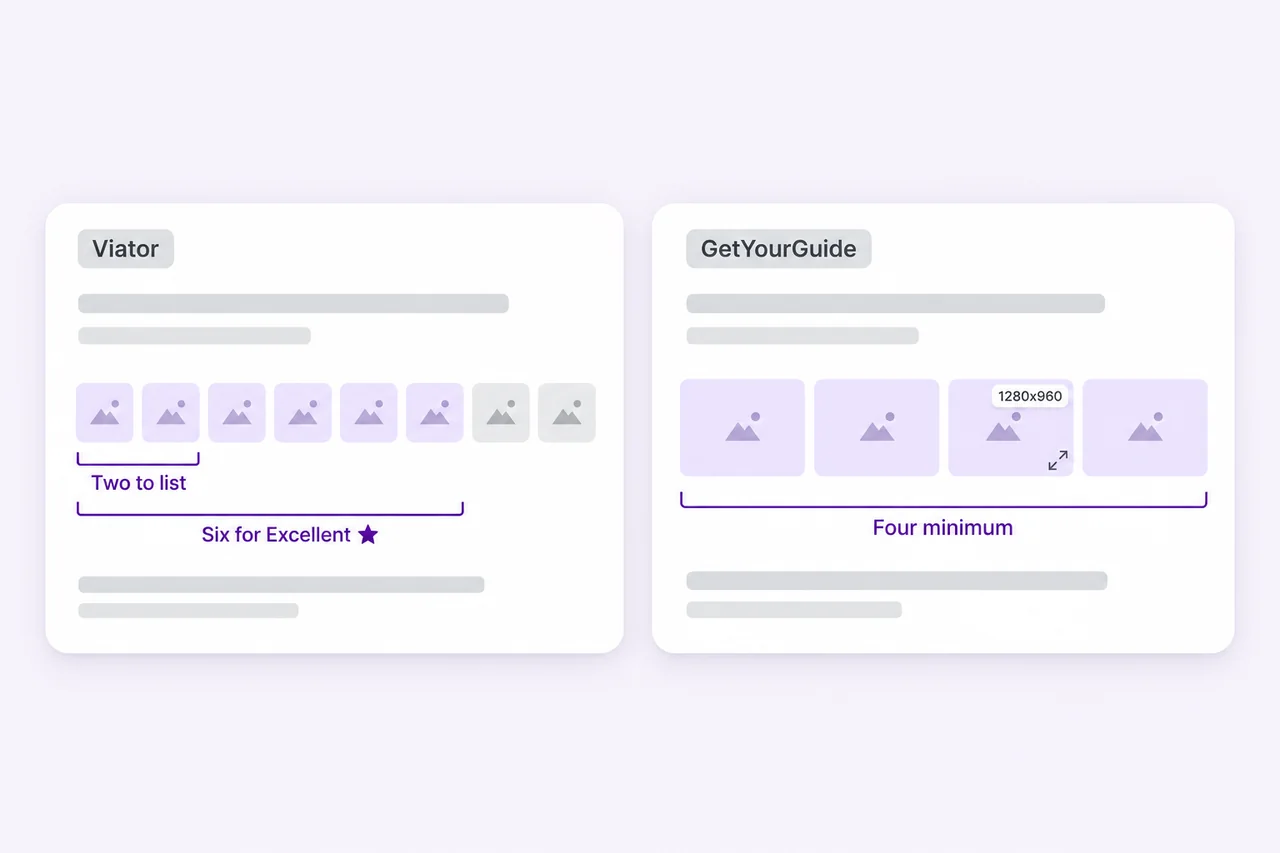
Viator: there is a one-time, non-refundable $29 submission fee per experience, which covers a manual review. Products need at least two clear, professional photos to be listed and six or more to reach Viator's "Excellent" quality level; Viator's July 2026 guidance suggests more than seven. Viator also rejects duplicate products and listings in saturated categories.
GetYourGuide: every new activity is reviewed before and after it goes live, and "most activities will be reviewed within a few days". Photos must be landscape, at least 1280x960 (ideally 2048x1536), at least four per activity; avoid watermarks and logos. Get it right the first time: a rejected activity "cannot be resubmitted".
For step-by-step setup help, see our Viator Extranet guide. For GYG, the GetYourGuide Supplier Portal guide covers registration through optimization.
GetYourGuide Originals: what it was and what it is now
Two different programs have carried the name. From 2018, GetYourGuide Originals were tours designed by GetYourGuide with a local operating partner and sold under GetYourGuide's brand; operators told Arival (republished by PhocusWire) that GetYourGuide charged a higher commission on them and gave them more search visibility. In November 2022 GetYourGuide confirmed it was phasing that program out.
In March 2023 GetYourGuide relaunched the name as Originals by GetYourGuide, presented at launch as exclusive experiences made with selected local partners and "not bookable anywhere else"; today its page describes "a collection of our most immersive and unforgettable experiences". GetYourGuide's 2026 terms list the factors its ranking uses, including the commission rate and a listing's past performance, and do not mention a preference for its own products.
The lesson from the first program still holds: a product sold under the platform's brand builds the platform's reviews, not yours. Decide with that in mind if you are invited.

Which Is Better for YOUR Business? A Decision Framework
"Which is better" is the wrong question. The right question is "which is better for my specific situation right now." Here is how to think about it:
- Where do your guests come from? We found no published split of either platform's customers by country, so look at your own bookings per channel before you decide where to put effort.
- How much does payout timing matter? GetYourGuide's twice-monthly runs cost 2%; Viator offers weekly PayPal payouts.
- Are your listings ready for review? Viator charges $29 per experience to review it. GetYourGuide has no listing fee but does not accept a rejected activity again.
If you can handle the work, listing on both with one booking system keeping availability in step spreads your risk.
After you list, two things decide what each channel really earns you: how you set prices within each OTA's rate rules (see rate parity and dynamic pricing on Viator and GetYourGuide) and the numbers you track per channel, such as look-to-book ratio and net margin per booking (see the OTA KPIs for tour operators).
Final Verdict: The Honest Recommendation
Viator and GetYourGuide side by side
Getting listed
Viator charges $29 per experience to review it; GetYourGuide has no listing fee but does not accept a rejected activity again.
Paying for visibility
Both let you pay more commission for visibility: Viator in ad impressions, GetYourGuide with no guaranteed position.
Guest contact
Both limit guest contact to the booking: GetYourGuide relays email until seven days after the tour and bans marketing to its customers; Viator allows marketing only with the guest's own permission.
Scroll the steps or pick a number
Viator and GetYourGuide compared on three rules: Viator charges $29 to review a listing while GetYourGuide has no listing fee and no second try; both sell visibility for more commission; both limit guest contact to the booking.
| Factor | Viator | GetYourGuide |
|---|---|---|
| How your rate is set | Minimum per destination and category; new products start at the minimum; no published range | Between 20% and 30% depending on the country; your rate is shown in your supplier account |
| What commission is calculated on | Viator sets the retail price and pays a net rate: the one you set, or your retail rate minus a commission percentage | The retail price, including taxes and fees |
| Paying more for visibility | Viator Accelerate: extra commission buys ad impressions; opt out at any time | A voluntary increase "may have a positive effect on ranking, but does not guarantee any position" |
| Standard payout | Monthly: in the EU for the previous month's experiences; outside the EU and UK within 21 business days after the settlement period | Monthly, by the 5th business day, for tours that ran the previous month |
| Faster payout | Weekly via PayPal | Twice a month for an extra 2% |
| Fee to list | One-time, non-refundable $29 per experience | No listing fee; a rejected activity cannot be resubmitted |
| Guest contact | Lead traveller's contact details shown in the booking when provided; marketing only with the guest's direct permission | Email through temporary relay addresses until seven days after the activity; marketing to its customers is banned |
| Cancellation policy | Standard policy (recommended; about 85% of products): full refund up to 24 hours before. Whichever you choose, it may not be stricter than on any other channel | Full refund up to 24 hours before by default |
Writing your own policy? See our tour cancellation policy templates.
But here is the uncomfortable truth. Neither OTA should be your main revenue channel long-term. Both charge commission on every sale and keep the customer relationship. Both rank listings with algorithms whose weights you cannot see, and GetYourGuide's terms allow cost-driven commission increases with four weeks' notice.
This isn't a new worry. Operators have said it on the record for years. Robert Graff of Bindlestiff Tours put the risk plainly in 2019: "you've got to make sure you don't have everything maybe in one place… where someone knows more about your business than you do." Chris Torres made the same point in Tourpreneur's review of 2019: "your brand is not at the forefront, and you're also not in charge of your own customer data… that is a major issue." In a show of hands at his 2025 talks, Tourpreneur's Peter Syme found that about 95% of the operators in his audiences work with five or fewer distribution partners, and only 1% with thirty or more.
Managing Both Platforms Without Losing Your Mind
Running both platforms plus your own website is messy. Availability sync, booking confirmations, guest comms, reconciliation, reviews. Everything times three. It compounds fast.
Manual management works while volume is low; after that, you either automate or you start making mistakes that cost you money and reviews:
- Channel manager / booking engine: Bókun, FareHarbor, Ventrata or another booking system that connects to both OTAs, to sync availability across Viator + GYG + your website in real time. Without this, double-bookings are a matter of when, not if.
- Unified calendar view: One place showing tomorrow's tours regardless of source. Not three tabs, three dashboards, three different versions of the same day.
- Financial reconciliation: What Viator owes you (weekly via PayPal, or monthly via bank transfer or Payoneer), what GetYourGuide owes you (monthly, or twice a month for 2% more), what direct bookings already settled. Without a spreadsheet that becomes a full-time job by July.
- Guide assignment: Three booking sources feeding into one tour. Final guest count often not known until the day before departure. Someone needs to tell the guide how many people are showing up.
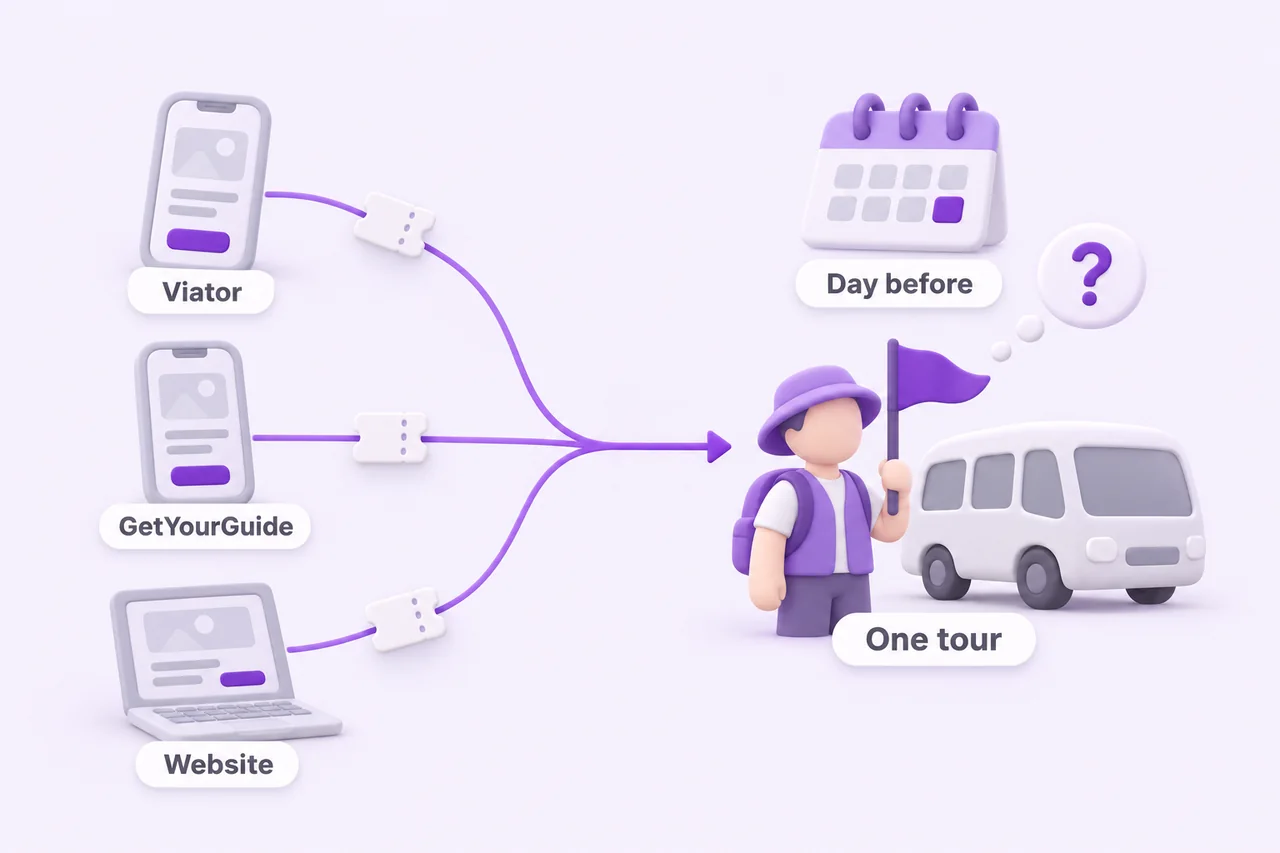
This is the problem Automate Travel works on. It connects to your booking system (Bókun, FareHarbor or Ventrata), so bookings from Viator and GetYourGuide that reach you through it sit in one view with your direct bookings. From there you plan the day: guest counts, guide assignments, and costs and margin per tour.
Two more jobs start the moment a booking lands: covering the tour and answering the guest. With guided tour software, guides mark on their phone when they are free, and the office decides who is asked or assigned: the first guide to accept a request takes the tour. With guest communication software, your email and WhatsApp conversations with a guest sit next to their booking, and messages from the OTAs land in a shared inbox where you can link them to the booking.
Frequently Asked Questions
Which has lower commission, Viator or GetYourGuide?+
Neither publishes a single rate, so there is no honest one-line answer. Viator sets a minimum commission per destination and category and publishes no range; one operator quoted 27% to Arival in 2025. GetYourGuide says it charges between 20% and 30% depending on the country, with your exact rate in your supplier account. Compare the rate you are offered and what it is calculated on: Viator works from a net rate (the one you set, or retail minus commission), GetYourGuide from the retail price including taxes.
Does GetYourGuide pay faster than Viator?+
GetYourGuide pays monthly, by the fifth business day, for tours that ran the month before; for an extra 2% it pays twice a month, around the 5th and 20th. Viator pays after the travel date, weekly via PayPal or monthly via bank transfer or Payoneer; outside the EU and UK its agreement sets the monthly payment within 21 business days after the settlement period. Both pay after the tour date.
Can I list on both Viator and GetYourGuide at the same time?+
Yes. Watch two things. Both ask for parity: GetYourGuide's terms require prices, availability and restrictions equal to or better than in your own online shop, and Viator requires the lowest net rate you offer any third party and no stricter cancellation policy than for guests who book with you directly or through any other channel. And keep one availability: a booking system connected to both stops the same seat from selling twice.
Which platform has better customer support for operators?+
Viator runs supplier support around the clock in English, by chat and phone, with Spanish and Italian at set hours. GetYourGuide runs a supplier support chat, still labelled beta, open 24/7 to active suppliers in English, Italian, French, Spanish and German, and points more complicated issues to its contact form. We found no published response times or account-manager thresholds, so ask during onboarding.
What is GetYourGuide Originals?+
Two programs have used the name. From 2018, Originals were tours designed by GetYourGuide, run by a local operator and sold under GetYourGuide's brand; GetYourGuide said in November 2022 it was phasing them out. In March 2023 it relaunched the name for exclusive experiences made with selected local partners, which its page now calls "a collection of our most immersive and unforgettable experiences".
Which platform is better for new operators just starting out?+
Viator charges a one-time $29 per experience for its manual review and lists products with at least two good photos. GetYourGuide reviews every new activity, usually within a few days, asks for at least four landscape photos of 1280x960 or more, and does not accept a rejected activity again. Prepare GetYourGuide listings carefully.
Do Viator and GetYourGuide share customer data with operators?+
Only for the booking. GetYourGuide routes email through temporary relay addresses that work until seven days after the activity, and its terms ban marketing to its customers. Viator shows the lead traveller's contact details in the booking when the traveller provided them, and its agreement bans marketing to them without their direct permission. To build your own guest list, ask guests for consent during the tour.
Which OTA has better API integration for booking engines?+
Both connect through booking systems. Viator integrates with over 100 systems, and its summary of the August 2026 agreement says that for connected suppliers your booking software's live data is the single source of truth, so errors it sends are yours. GetYourGuide's Supplier API connects to systems such as Bókun, FareHarbor, Ventrata, Bookingkit and Checkfront. Viator and Bókun are both owned by Tripadvisor.
Should I rely on Viator or GetYourGuide as my main sales channel?+
Neither, long-term. Both charge commission on every sale and keep the customer relationship, and GetYourGuide raised commission for some operators in mid-2025. Treat them as a discovery engine and grow direct bookings alongside, so a ranking change cannot sink your quarter.
I'm a traveller. Should I book on Viator, GetYourGuide or directly with the operator?+
The same local company may run the tour whichever site you use, so compare the things that change: the price, the cancellation terms shown before you pay, and the reviews for that specific tour. If the operator has its own website, booking there usually means more of what you pay stays with the people who run the tour, and you can ask them questions directly. This guide is written for operators.
Viator + GetYourGuide + Direct. One view.
Bookings from every channel that reaches your booking system, in one operational view with guide assignments and costs per tour.
Book a DemoYour booking engine handles the sale. What handles everything after?
automate.travel consolidates bookings, finances, team scheduling, and guest communication from Bókun, FareHarbor, and Ventrata, in one system.
Related Comparisons
Related Solutions
Was this article helpful?
One click. It tells us what to write next.